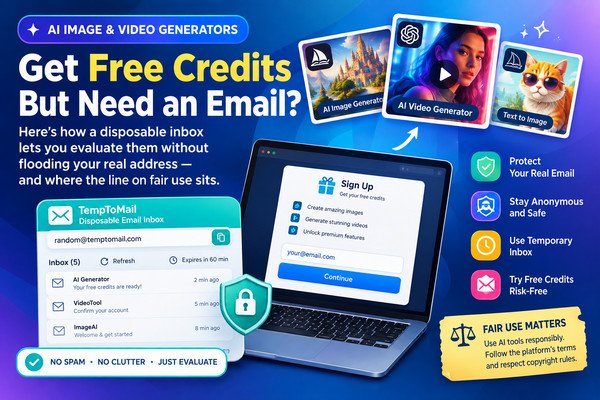
Search interest in "AI image generator no sign up" and "AI video generator free credits" has climbed steadily through 2026, and it is easy to see why. Tools like Runway, Pika, Kling, HeyGen, and a long tail of newer image and video generators hand out a batch of free credits the moment you create an account — but almost none of them let you generate anything without an email address first. That single requirement is the entire reason "no signup" has become its own search category: people want to try the tool, not hand over a permanent piece of their identity to evaluate a five-second video clip.
Why almost every free AI tool asks for an email
Running an image or video model costs real compute per generation, so free tiers exist to let a company demonstrate quality and convert a fraction of trial users into paying customers — not to give unlimited generations away. Requiring an email address serves that business goal in three ways: it lets the company measure how many unique people are trying the product, it gives them a channel to send conversion emails after your free credits run out, and it makes it at least mildly inconvenient to reset your free allowance the moment it's gone. None of this is unreasonable from the company's side — but it does mean that "free" almost always comes with a small, permanent cost to your inbox: one more company that now has your address indefinitely, and one more source of "your credits are running low" marketing email.
The problem with using your real inbox
Handing your everyday email address to a new AI tool every time you want to test one adds up faster than it seems. A few sign-ups a month across image generators, video generators, voice-cloning tools, and logo makers can mean dozens of new companies holding your address within a year — each one a potential source of marketing email, each one a target if that company has a data breach, and each one another place your address sits waiting to be sold to a data broker if the company later changes ownership or shuts down. None of this is catastrophic on its own, but it is exactly the kind of slow accumulation that eventually turns a clean inbox into an unmanageable one.
Where a disposable inbox genuinely helps
A temporary address is the right tool specifically for the "am I going to actually use this?" phase of trying a new AI generator — before you've decided whether the output quality, style, and workflow are good enough to justify a real account or a paid plan. Typical scenarios:
- One-off testing. You saw a new text-to-video tool mentioned online and want to see what its output actually looks like before deciding whether it's worth bookmarking.
- Comparing several tools back-to-back. Running the same prompt through three or four generators to compare quality is common practice for creators choosing a tool — and it is far cleaner to do that evaluation with disposable addresses than to create four permanent accounts you'll only ever use once.
- Confirming a verification email even arrives. Some AI tools have flaky onboarding — a confirmation link that never sends, a broken redirect. A disposable inbox with a visible, live view lets you confirm the flow actually works before committing your real address to it.
- Classroom or workshop demonstrations. Instructors showing a room full of students how an AI tool works often need a fresh, disposable account on the spot rather than logging into a personal one in front of a class.
Where the fair-use line actually sits
It's worth being direct about this rather than glossing over it: using a disposable address to try a tool once, before deciding whether to commit to a real account, is a normal and reasonable use of the technology. Using a disposable address specifically to generate a new free-credit batch over and over, indefinitely, to avoid ever paying for a tool you use regularly, is a different thing — many platforms' terms of service explicitly forbid this, and some detect and block it technically (shared IP ranges, device fingerprinting, and known disposable-mail domains are all common signals platforms already watch for). The email address itself is neutral technology; what turns it into a terms-of-service problem is the pattern of use on top of it. If a tool is genuinely useful to you on an ongoing basis, the honest move is to pay for it or use its intended free tier as designed, not to route around its limits indefinitely.
A practical walkthrough
- Open TempToMail and copy the generated address.
- Paste it into the AI tool's signup form exactly as shown — a single dropped character means the verification email goes nowhere.
- Watch the live inbox on this page; most verification emails and OTP codes arrive within a minute or two.
- Complete the tool's onboarding and generate your test image or video clip.
- Decide whether the tool is worth a real account. If yes, sign up again properly with your actual email so you can recover access later and receive any support communication.
If a signup takes longer than expected, a page with a longer timer — such as 30 minute mail or 50 minute mail — gives you more breathing room than the default session without needing to regenerate an address mid-flow.
Free-tier signup patterns, compared
Free-tier structures vary across AI image and video tools, and the pattern matters for how you should plan a test session:
| Pattern | What it looks like | Best temp-mail approach |
|---|---|---|
| One-time credit batch | A fixed number of credits granted once at signup, non-renewing | A short session is enough — generate, test, done |
| Daily free allowance | A small number of free generations that reset every 24 hours | Only useful for a single session; daily resets don't carry over across a disposable address |
| No-signup browser tools | Generate directly with no account at all, often with a lower-quality or watermarked result | No temp mail needed — these already solve the privacy question themselves |
| Free trial of a paid tier | Full-featured access for a limited number of days, requiring payment details eventually | Use your real email — a trial you're evaluating seriously is not a one-off test |
FAQ
Will AI tools reject a disposable email address at signup?
Some do. Platforms that have been targeted by credit abuse in the past sometimes block known disposable-mail domains outright, the same way certain banks and government portals do. If a signup is rejected, that's usually the platform's own anti-abuse system working as intended, not a bug in the temp-mail service.
Is it better to use one disposable address for every AI tool I test, or a new one each time?
A new address per tool. Reusing one address across several AI platforms links those accounts to each other in exactly the way disposable email is meant to avoid, and it also means one expired session locks you out of every tool you tested with it at once.
Should I use a disposable address for a tool I plan to use regularly?
No — use your real email. A disposable inbox is for evaluation, not for long-term accounts you'll want to recover, receive support from, or eventually pay for.
What happens to an AI tool account if the disposable session expires?
The account itself usually keeps existing on the AI platform's side — a disposable address only affects your ability to receive new mail at it, not accounts you've already verified. But if the platform ever needs to send a password reset, a billing notice, or a support reply to that address later, it will go nowhere, since the inbox no longer exists. This is exactly why a disposable address is unsuitable for anything beyond a one-time evaluation: the account can outlive the mailbox, silently cutting off any future communication from that service.
Do AI companies actually mind disposable email being used to test their product?
Most companies are fine with someone trying their product once before deciding whether to commit — that's the entire point of offering a free tier in the first place. What draws attention from a platform's anti-abuse systems is the repeated pattern of resetting credits, not a single evaluation session. The distinction is usage frequency and intent, not the mere fact that an email happens to be disposable.
For a broader look at how disposable addresses work and when they make sense outside of AI tools specifically, see our main guide to disposable temporary email. If you're testing tools as part of an automated workflow rather than by hand, our guide on disposable email for QA and CI pipelines covers the API-driven side of the same idea.