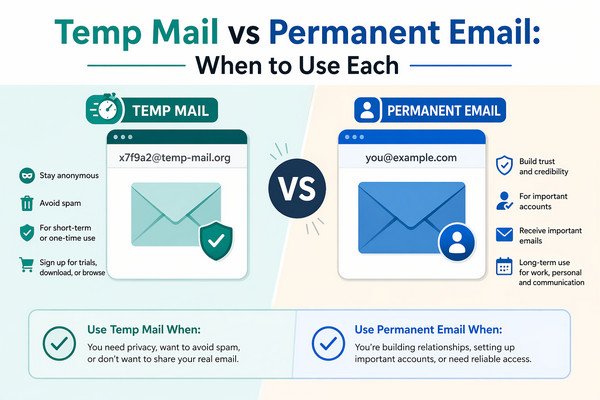
Defining the Two Email Types
What is Permanent Email?
Permanent email addresses are the traditional email accounts we create with providers like Gmail, Outlook, Yahoo, or custom domains. These accounts are designed for long-term use, offering extensive storage, organizational features, and integration with other services.
What is Temp Mail?
Temporary email, or temp mail, refers to disposable email addresses that exist for a limited time—typically minutes to days. Services like TempToMail generate these addresses instantly without registration, providing a quick solution for receiving emails without exposing your real identity or primary inbox.
Direct Comparison: Temp Mail vs Permanent Email
| Feature | Temp Mail | Permanent Email |
|---|---|---|
| Lifespan | Minutes to days (temporary) | Months to years (long-term) |
| Creation Time | Instant (seconds) | Minutes (requires registration) |
| Privacy Level | High (no personal info required) | Low to Medium (requires personal data) |
| Storage Capacity | Limited (temporary storage only) | Extensive (GBs of storage) |
| Sending Capability | Receive only (no sending) | Full send/receive functionality |
| Attachment Support | Limited (small files only) | Full support (large attachments) |
| Spam Protection | Built-in (address expires) | Filter-dependent (requires setup) |
| Cost | Free (no payment required) | Free or paid (premium features) |
When to Use Permanent Email
Professional Communications
Business correspondence, client communications, and professional networking require a permanent, professional email address that establishes credibility and continuity.
Financial Accounts
Banking, investment, payment services, and financial platforms demand permanent email addresses for security, recovery options, and transaction notifications.
Government Services
Tax filings, official documentation, and government correspondence require reliable, permanent email addresses for important communications.
Healthcare Portals
Medical records, prescription services, and healthcare communications need permanent email addresses for sensitive health information.
When to Use Temp Mail
Website Registrations
Forums, download sites, and services you're testing that require email verification but may send promotional content later.
Newsletter Subscriptions
When you want to access content but don't want to commit your primary inbox to ongoing communications.
One-Time Downloads
Ebooks, whitepapers, software trials, and other resources that require email registration for access.
Contest Entries
Sweepstakes, giveaways, and competitions that might lead to increased promotional emails.
The Hybrid Approach: Best of Both Worlds
Email Forwarding Services
Services like SimpleLogin or addy.io allow you to create aliases that forward to your permanent email, offering some privacy benefits while maintaining permanent access.
Domain-Based Solutions
Using your own domain with catch-all or subdomain addressing lets you create unique addresses for different services while maintaining control.
Quick Decision Guide
Ask yourself these questions before choosing:
- Will I need ongoing access to this account in 6 months? → If yes, use permanent email.
- Does this service handle sensitive personal information? → If yes, use permanent email.
- Is this a one-time or short-term interaction? → If yes, use temp mail.
- Would a data breach at this service significantly impact me? → If yes, use permanent email with 2FA.
If you answered "no" to all but question 3, temp mail is the right choice.
Security Considerations
Permanent Email Security
Permanent emails require strong security practices: two-factor authentication, strong unique passwords, regular security checks, and awareness of phishing attempts.
Temp Mail Security Advantages
Temp mail offers inherent security through obscurity—the addresses are random and temporary, making them difficult to target. No personal data is stored, reducing breach risks.
Future Trends in Email Management
The distinction between temporary and permanent email is blurring with services offering more flexible solutions. We're seeing increased adoption of:
- Privacy-focused email providers with built-in alias features
- Decentralized email systems using blockchain technology
- AI-powered email management that automatically categorizes and prioritizes messages
- Increased integration between temporary and permanent email solutions
Conclusion
Choosing between temp mail and permanent email isn't an either/or decision—it's about strategic deployment of the right tool for each situation. Permanent email serves as your digital identity foundation, while temp mail acts as protective shielding for your privacy.
The modern approach involves maintaining 1-2 permanent email addresses for important communications while leveraging temp mail services like TempToMail for situations where privacy, spam avoidance, or temporary access is needed. This hybrid strategy maximizes both convenience and security in our increasingly digital world.